Why Your CRM is Gaslighting You: The Lead vs. Account Paradox
Discover why routing individual leads to account executives breaks your revenue engine, and how transitioning to Marketing Qualified Accounts (MQAs) aligns sales and marketing.
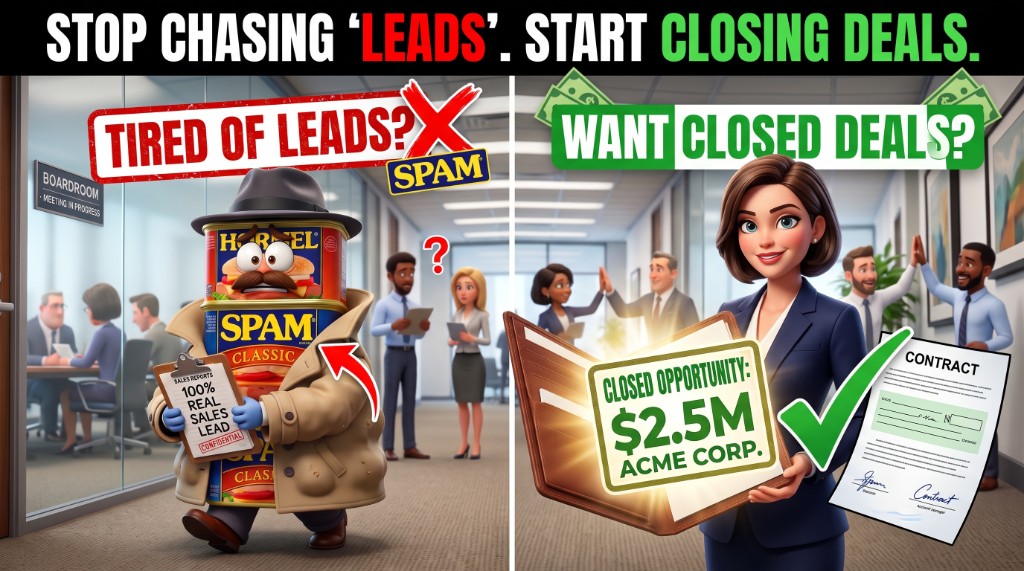
Every Account Executive in enterprise software is handed a patch of Accounts. Their quotas, their commission checks, and their ultimate survival in the role are dictated entirely by their ability to navigate complex buying committees and close those specific logos.
So why is Marketing still handing them Leads?
It is the ultimate go-to-market paradox. We have built a revenue engine where the left hand is comped on volume, the right hand is comped on revenue, and the software sitting between them is lying to both.
The Anatomy of a Broken Handoff
Walk onto any sales floor and you will see this disconnect in real time. An AE is staring at their top 50 target accounts, trying to map the economic buyer and procurement roadblocks. Suddenly, the CRM pings them with a "Hot MQL."
Doug clicked an ad. Dave from DevOps starred a GitHub repo.
Marketing celebrates, but to the AE, Doug and Dave are isolated noise. Reaching out with an automated "Saw you downloaded our whitepaper, want to book 15 minutes?" is a guaranteed way to burn a bridge. The rep doesn't need a name and a low-intent action. The rep needs to know if that action means the Account is ready to buy.
The Systems Trap: ABM Theater
Legacy marketing automation platforms were built for email blasts to individuals. When marketing tools force an Account-based reality through a Lead-based funnel, the result is "ABM Theater." Companies claim they are doing Account-Based Marketing, but underneath the hood, they are still just scoring individual leads and tossing them over the fence.
To actually align Sales and Marketing, you have to change the currency they trade in. You have to stop handing Sales a Lead, and start handing them a true Marketing Qualified Account (MQA).
What an Actual MQA Looks Like
A real MQA transcends surface-level engagement. It is a synthesized thesis that connects a company's macro business initiatives directly to specific, actionable technical pain points.
Imagine swapping out Doug's ad-click for a bespoke sales kit detailing a high-growth fintech prospect. Instead of a naked MQL, Marketing hands the AE this intelligence:
- The Compelling Event: The company recently hit a $22B valuation and is aggressively expanding into institutional block trading. Their trading volume has grown 50x.
- The Architectural Pain: This hyper-growth is straining their core OSS data platform, creating a massive time-series cardinality cost and risking platform stability. Users are already reporting bugs and payout delays.
- The Mapped Committee:
- The CEO is focused on maintaining market integrity and de-risking the new institutional product expansion.
- The COO needs to control the infrastructure compute cost per TB ingested.
- Engineering Leadership requires a re-architected backend to guarantee sub-second p99 query latency and robust cluster scale headroom.
- The Execution Strategy: The AE doesn't ask for 15 minutes to demo software. Armed with proactive objection handling—like anticipating the prospect will try to solve scaling issues in-house due to their active hiring of SREs—the rep opens with a surgical hook. They ask: "With trading volume up 50x, how are you ensuring your observability backend doesn't become your biggest cost center or your primary source of production incidents?"
Rebuilding the Revenue Engine
When you change the deliverable from a name on a spreadsheet to a validated architectural thesis, the entire GTM dynamic transforms.
Marketing is no longer a lead-generation factory measured by form fills; they become an intelligence unit measured by validated pipelines. Sales stops spamming developers with meeting requests and starts executing peer-to-peer consulting. They approach engineering leadership not to pitch software, but to discuss the specific Day-2 operations and scaling roadblocks that their own developers are already fighting in the trenches.
If we expect sales teams to hit quotas based on Accounts, we have to arm them with intelligence built for Accounts. The moment you stop optimizing for leads is the moment you start generating actual pipeline.