The Death of the MQL: Why Revenue Teams Are Shifting to the Insight Dossier
Discover why B2B revenue teams are abandoning the traditional MQL in favor of the Insight Dossier to drive strategic account-based selling and close more deals.

For over a decade, the standard contract between B2B marketing and sales has been simple, yet fundamentally flawed: Marketing generates a list of individuals who downloaded a whitepaper or attended a webinar, rebrands it as a "Marketing Qualified Lead" (MQL), and tosses it over the fence.
Sales is then instructed to "call Bob and book a demo." When Bob inevitably hangs up, the pipeline stalls, and the classic finger-pointing begins. Marketing claims Sales isn't working the leads; Sales claims the leads are just glorified telemarketing lists.
To build a modern revenue engine, marketing and demand generation teams must stop delivering disconnected names and start delivering a comprehensive map of the account. This evolution—from the MQL to the Marketing Qualified Account (MQA)—is fully realized through the Insight Dossier.
The Paradigm Shift: From Trigger to Thesis

Strategic account-based selling requires reps to act as trusted advisors, not aggressive telemarketers. To do this, they need to bypass generic discovery questions and lead with an informed perspective on the prospect's business.
The Insight Dossier replaces the traditional lead handoff with an Architectural Pain Thesis. Rather than just noting that an employee interacted with a piece of content, marketing equips the sales team with deep context:
- Target: The exact nature of the company and its market position.
- Trigger Signal: Specific catalysts for change, such as closing a massive funding round, doubling headcount, or launching a new product line.
- The Thesis: A heavily researched assumption about the technical debt, scaling limits, or operational friction the company is experiencing right now.
- The Opening Hook: A calibrated, executive-level question that challenges the prospect's status quo.
Living Where Sales Lives: Embedding Insights into the CRM
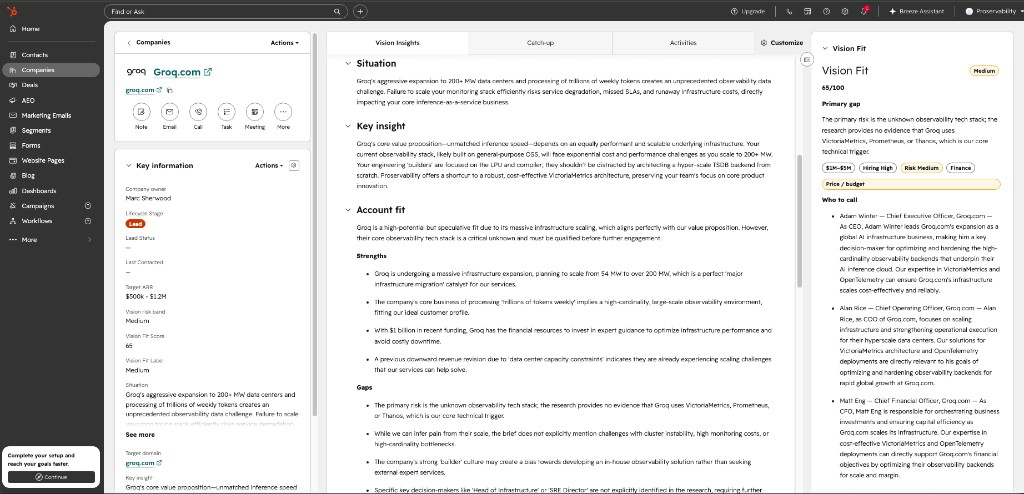
The fastest way to ensure a sales team ignores a brilliant marketing insight is to put it in a separate PDF or a disconnected tool. To drive revenue, these dossiers must be injected directly into the CRM where account executives already work.
When a seller opens a target account like Groq.com in HubSpot, they shouldn't have to hunt for context. By embedding a dedicated "Vision Insights" tab directly into the company record, reps can instantly review the situation, key insights, and specific account fit strengths and gaps. They can immediately see who to call, alongside customized talking points for executives like the CEO and COO.
Equipping Reps for the C-Suite
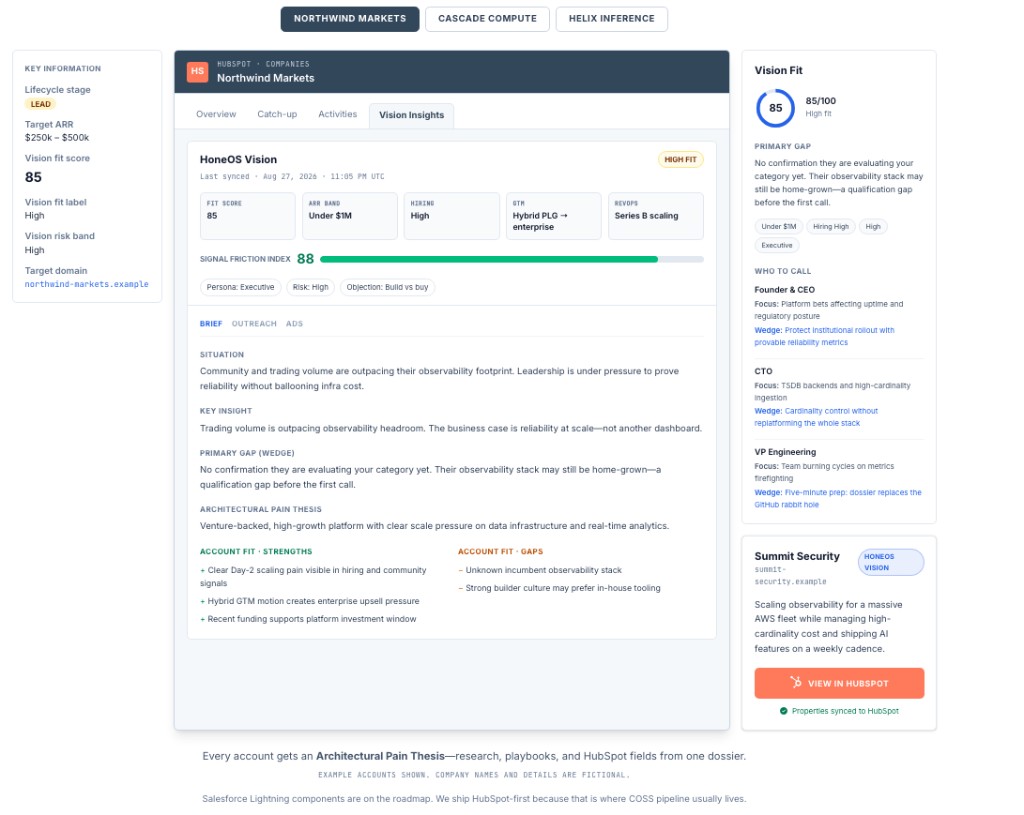
An effective Insight Dossier breaks down the strategic approach persona by persona. Every account gets an Architectural Pain Thesis, complete with research and playbooks driven from one central dossier.
For example, a dossier for a target like Northwind Markets gives sales teams an immediate read on the account's viability via a "Vision fit score" and a "Signal Friction Index". Crucially, it hands the rep customized "Wedges"—specific angles of attack tailored for the Founder & CEO, the CTO, and the VP of Engineering.
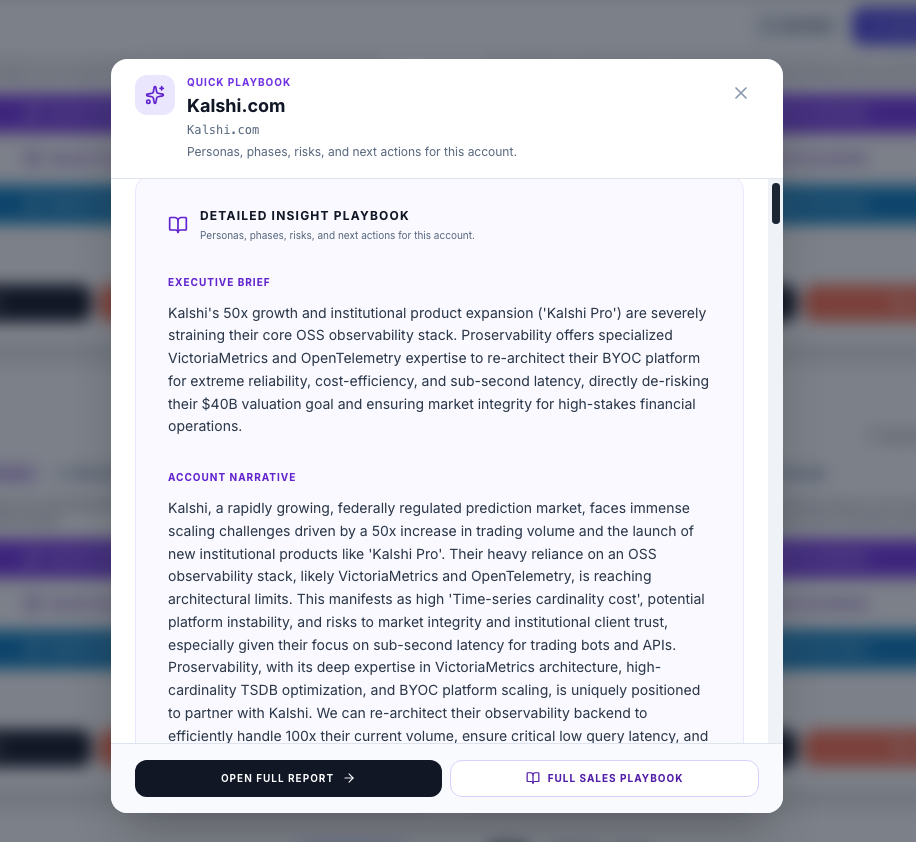
When rapid execution is necessary, reps can access a "Quick Playbook" that provides a concentrated Executive Brief and a detailed Account Narrative. This allows a seller engaging with a high-growth company like Kalshi to immediately speak to the strain on their core observability stack, instantly establishing credibility.
By replacing generic MQLs with bespoke Insight Dossiers pushed directly into the CRM, marketing gets to do the deep, strategic work they excel at—proving their direct impact on the pipeline. Simultaneously, sales teams are thrilled to receive actionable, account-based intelligence that allows them to start conversations at the executive level. This isn't just a better handoff; it is a unified revenue motion that gets your team one step closer to closed-won.