Your CRM Isn't Lying. But It Might Be Telling You the Wrong Story.
Your CRM may be accurate but misleading. Explore the gap between how teams sell, what customers experience, and what leadership thinks is happening.
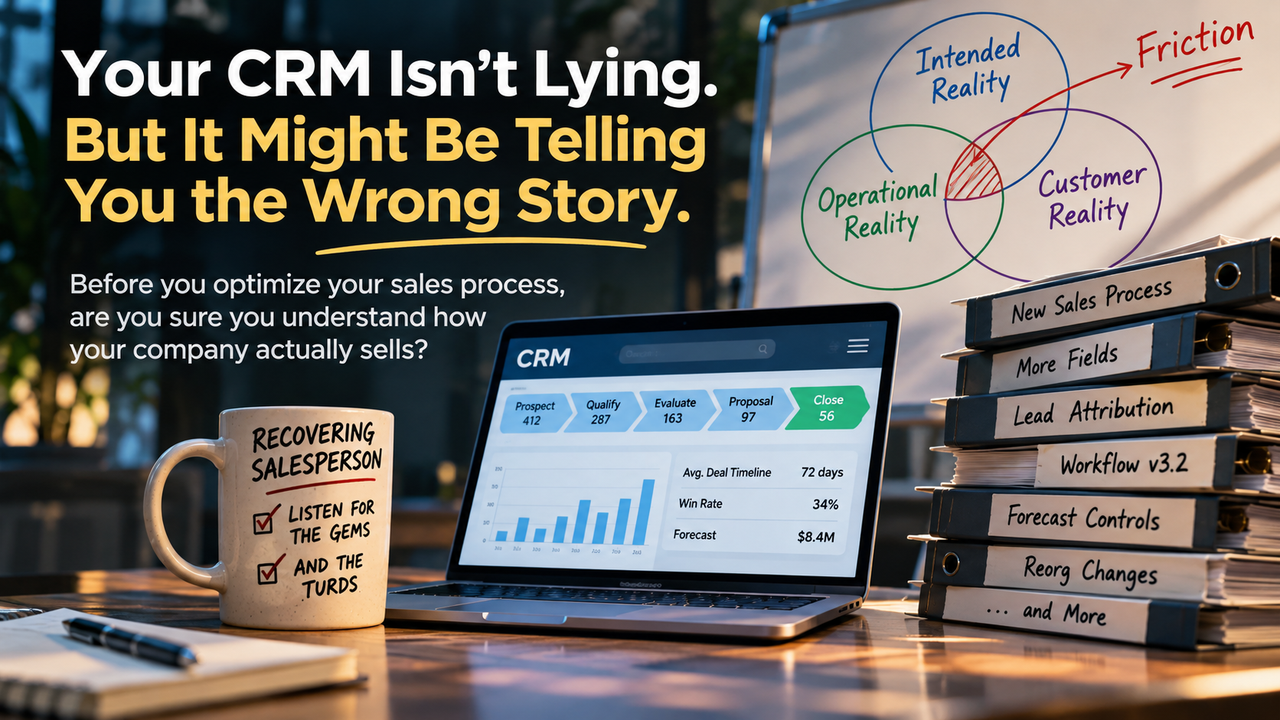
Before you optimize your sales process, are you sure you understand how your company actually sells?
I've spent enough years working in technology companies to notice something interesting. The bigger and more established an organization becomes, the more sophisticated its understanding of the customer journey appears to get.
There are dashboards. Funnel reports. Conversion metrics. Pipeline forecasts. Attribution models. Beautiful diagrams showing exactly how a prospect becomes a customer.
Everything is measurable. Everything has an owner. Everything has a process.
And yet, I'd wager that many executives would be genuinely surprised if they experienced their own company's buying journey. Not the journey described in the quarterly business review. The actual one. From the first website visit to the first sales conversation, through technical evaluation, procurement, and everything in between.
Because sometimes the difference between the brochure and the experience is rather like arriving at an Airbnb. The pictures were lovely. The reality is... educational.
The CRM Isn't Reality. It's a Recording of Reality.
Let's start with something I've seen repeatedly. A technology company releases a new product capability. Product is excited. Marketing builds the launch campaign. There are presentations, announcements, enablement sessions, and perhaps a webinar or two. Leadership wants to know how the market responds. Meanwhile, the sales team has deals to close.
Imagine you're an account executive working an opportunity that's well on its way toward closing. The customer understands the offering. You've addressed their objections. Things are moving. Now there's a new feature or product option. Do you immediately introduce it? Maybe. But if it doesn't address something the customer is already asking for, why risk complicating a deal that's progressing nicely? Why introduce another variable, another decision, or another potential reason to delay?
I've seen salespeople make that decision many times. And having been on that side of the conversation, I understand it.
But look at what happens next. Marketing sees limited engagement with the new capability. Product sees little evidence of demand in the pipeline. Leadership starts questioning the commercial opportunity. And somewhere along the way, an assumption becomes a conclusion.
Customers aren't interested.
Except we haven't established that. We've established that the capability wasn't discussed very often. Those are not the same thing.
The salesperson might have made exactly the right decision for the opportunity in front of them while inadvertently contributing to a misleading picture of market demand. Nobody has to be incompetent for the organization to reach the wrong conclusion. In fact, that's what makes this problem so interesting.
Your CRM Is Probably an Archaeological Site
I have yet to encounter many mature CRM implementations that haven't become elaborate collections of historical decisions. A new sales leader arrives and changes the qualification process. Marketing needs better attribution. Finance wants more accurate forecasts. Product wants additional information about customer requirements. RevOps adds a workflow. Somebody adds a mandatory field. Then another.
Eventually, you're dealing with an impressive structure of fields, rules, automations, exceptions, and dependencies that nobody entirely understands. It works. Mostly.
But here's something worth asking: Does it still reflect how the organization actually sells? Or does it reflect how the organization sold three reorganizations ago?
Salespeople are remarkably good at adapting. Give them an inefficient process, and they'll find a more efficient way to get their work done. That doesn't automatically make them undisciplined or resistant to change. It may simply mean they have customers to serve, quotas to meet, and a limited number of hours in the day.
If a process requires twenty minutes of administrative effort and produces no obvious benefit for the salesperson or customer, don't be terribly surprised when someone finds a way to do it in two. And when nothing changes except that they've saved eighteen minutes, the workaround becomes the process. At least, the real process. The documented one remains comfortably intact.
The Two Clocks Problem
Here's an exercise I'd encourage anyone responsible for sales operations to try. If your CRM supports field history or change tracking, look at when opportunities actually move between stages. Not just where they are today. Look at the timing of the changes.
I've seen opportunities move through stages around forecast review periods. Which makes sense. A review is approaching. People update their records. Opportunities get moved to where they should be.
But consider the implications. A customer completes a technical evaluation on Thursday. The salesperson updates the opportunity on Tuesday morning before the forecast meeting. According to the CRM, the stage changed Tuesday. According to the customer, it changed Thursday. Those are two different clocks.
The customer clock measures when things happen.
The CRM clock measures when someone records that they happened.
Now imagine that pattern repeated across a sales organization. Time-in-stage metrics might be distorted. Opportunities might appear to move unusually quickly through certain phases. Forecast activity may cluster around internal meetings rather than customer milestones. Leadership might identify a bottleneck that doesn't exist—or fail to notice one that does.
To be clear, this doesn't necessarily invalidate overall sales-cycle measurements. If opportunity creation and close dates are accurate, those metrics can still be useful. But the journey between those points may be less reliable than the dashboard suggests. And once we start optimizing based on that data, we risk fixing the wrong things.
When the System Breaks, People Adapt
I've seen broken processes suck the life out of good sales teams. And I don't mean salespeople complaining because someone asked them to fill in a field. I mean processes that consume time, create frustration, and provide little visible benefit to the people expected to follow them.
The team raises concerns. Leadership initially pushes back. Eventually, someone forms a tiger team. The tiger team studies the problem, holds meetings, creates recommendations, and sometimes adds yet another layer of process. If the underlying incentives and working practices aren't understood, the exercise can divide the teams it was supposed to bring together.
Eventually, the organization may bring in outside consultants. There's nothing inherently wrong with that. I'm offering consulting services myself, after all. But there's a particular trap here. If the consultant's primary job becomes validating the expectations of the people paying the bill, the organization can end up with a polished, expensive explanation of why the workforce needs to follow a process that nobody has properly examined.
The dashboards look better. Compliance improves. A new workflow gets deployed. And the people actually selling are still wondering why nobody asked how they do their jobs.
Here's the question I'd rather start with:
What if the salespeople working around your process are giving you some of the most valuable operational feedback you're receiving?
Not every workaround is good. But not every deviation from the documented process is a failure. Sometimes it's ingenuity. Sometimes it's an early warning. Sometimes it's both.
I'm a Recovering Salesperson
And I know to listen for both the gems and the turds.
If a company brought me in because its salespeople weren't following the CRM process, I wouldn't begin by examining the CRM. I'd begin with the salespeople. I'd spend time shadowing a few experienced, mid-level reps. Not watching their mouse clicks to see whether they're complying with procedures. Watching their actual working day.
- What interrupts them?
- What information do they need?
- What do customers ask that they struggle to answer?
- Which internal processes genuinely help?
- Which ones get in the way?
- What have they figured out that nobody else seems to know?
Then I'd speak with marketing, product, sales leadership, and the people supporting the customer journey. I'd want to understand what each group believes is happening, what they need from the others, and where their expectations differ. Then bring those perspectives together, carefully, to share observations and challenge assumptions.
Only after understanding the work would I start determining how the systems, workflows, and reporting should support it. Because the CRM is just one part of the problem. And sometimes it isn't the problem at all.
Three Versions of the Same Business
I think many organizations operate with three different versions of their go-to-market reality.
The intended reality: How leadership believes the organization operates.
The operational reality: How sales, marketing, product, and customer-facing teams actually get things done.
The customer reality: What prospective customers really experience as they discover, evaluate, and buy the product.
Those versions don't need to be identical. They do need to be connected. And that connection is particularly important in commercial open source and developer-focused technology companies.
Consider one product being described by three people. The founder wants to explain its revolutionary architecture. The salesperson wants to discuss transformational business outcomes. The engineer just wants to stop the database falling over every Thursday. All three perspectives matter.
But if the engineer can't explain the business value internally, the manager can't connect the operational benefit to organizational priorities, and the salesperson doesn't understand the original technical problem, the story breaks down. Technical people aren't merely waiting for executives to tell them which software to use. They discover products, evaluate them, advocate for them, and influence purchasing decisions upward. Budget decisions and strategic priorities travel downward.
A good GTM motion connects those directions. A bad one leaves everyone explaining a different product. And the CRM might happily report that the opportunity progressed through all the correct stages while those conversations failed to connect.
Have You Ever Tried Being Your Own Customer?
This is the question I'd love more executives to ask. Go to your website. Try to understand the product without relying on everything you already know. Follow the documentation. See what it takes to evaluate the offering. Look at the communications a prospect receives.
- Does the follow-up reflect their original interest?
- Does the technical champion receive information that helps them make the case internally?
- Does the sales conversation reinforce the value marketing promised, or replace it with a completely different story?
- What happens when someone raises their hand?
And perhaps most importantly:
Does anyone inside your organization have a clear picture of that entire experience?
Marketing may own the first interaction. Product may own onboarding. Sales may own the commercial conversation. Customer success may own what happens afterward. But the customer doesn't experience four departments. They experience one company. Or at least, they're supposed to.
Don't Fix the Process Until You Understand the Work
I don't believe the answer is necessarily another dashboard, a new methodology, or a more complicated set of CRM rules. Sometimes the most useful thing you can do is observe what actually happens. Listen to the people doing the work. Experience the journey from the customer's perspective. Compare those observations with the organization's expectations. Find the clever adaptations worth preserving. Find the broken processes worth fixing. And establish where information, context, and value are being lost between teams.
That's the thinking behind the GTM Reality Check and the broader GTM Friction Audit I've been developing.
The Reality Check looks at the journey from the outside: what prospective customers actually see, receive, and experience. The Friction Audit goes deeper into the organization: how people work, how the systems support them, how the messages connect, and where commercial momentum is being lost.
Neither starts with the assumption that someone is doing something wrong. Both start with curiosity. Because if you don't understand how your company actually operates, optimizing what you think is happening can make things worse. And I'd rather spend my time finding the gems and the turds than producing another beautiful dashboard explaining why everything is fine.
One Last Thought
Your CRM isn't your customer. Your process documentation isn't your process. And your intended customer journey isn't necessarily the one your customers experience.
All of them are useful representations of the business. None of them should be mistaken for the business itself.
Before you spend another dollar generating demand, find out what actually happens to the demand you already have.
And before you hire someone to fix the problem, make sure you're asking the right question.
Sell the question that makes people curious. Demonstrate the expertise when they want to understand the answer.
Marc Sherwood is a recovering salesperson, technical marketer, and builder who works with commercial open-source, infrastructure, and developer-tool companies.
He develops HoneOS, an account-intelligence platform for technical sales teams, and offers founder-led GTM Reality Checks, Friction Audits, and fractional GTM engagements.
Explore the GTM Reality Check: https://marcsherwood.com/gtm/