The Fatal Traps of Commercial Open-Source GTM Strategies
When your Go-To-Market strategy is misaligned with your product strategy, commercial open-source companies typically fall into one of several fatal traps.
When your Go-To-Market strategy is misaligned with your product strategy, your commercial open-source company is headed for a death spiral.
It's like an undetected memory leak in your startup's core operating system. Everything looks fine on the surface, user metrics are climbing, GitHub stars are shining—until the system quietly runs out of resources and the whole machine hard-crashes.
Commercial open-source companies generally fall into one of five fatal traps. They either give away so much that they destroy their own pipeline, starve the open-source version until the community dies, or completely misjudge the buyer journey.
Let's break them down.
01. Trap 1: Giving Away the Farm (and Bloating the Core)
This is the most common trap for engineering-led founders. Driven by the pure desire to build the absolute best tool and maximize adoption, they pack the open-source tier with complex, enterprise-grade features: advanced clustering, multi-tenant RBAC, and hyper-niche integrations.
This breaks the Go-To-Market model in two distinct ways.
First, it overcomplicates the core product. The beauty of successful open-source infrastructure is its simplicity and out-of-the-box performance. When you bake highly complex features into the free core, everyday users turn them on simply because they can. This introduces unnecessary friction and a massive support burden on the community.
Second, it triggers a catastrophic MQL-to-SQL collapse. When the open-source tier is too feature-rich, it creates a fatal illusion of success. You might generate an endless sea of Marketing Qualified Leads (MQLs) through downloads, but because the enterprise already has everything it needs to scale, those leads never convert to Sales Qualified Leads (SQLs).

In a healthy commercial open-source model, a strong engine should see an MQL-to-SQL conversion rate of 2% to 5%. When you give away the farm, that rate routinely plummets below 0.1%.
When you factor in the Cost of Goods Sold (COGS) for free users—cloud egress, documentation, and community support bandwidth—the math becomes toxic. If your blended COGS to support a single open-source MQL is $20, and your conversion rate is 0.1%, it costs your business $20,000 just to generate a single SQL.
If your Average Contract Value (ACV) sits around $30,000, your revenue model is upside down before the sales team even picks up the phone.
"You end up relying on 'Thank You' purchase orders from guilty engineering managers. A business model built on gratitude is not a business model."
The Golden Rule: The open-source core must remain brutally simple. "Enterprise" features should explicitly be those complex layers—compliance, advanced security, massive-scale orchestration—that signal true enterprise readiness and drive ACV.
02. Trap 2: Starving the Open-Source Core
On the exact opposite end of the spectrum is the "crippleware" approach.
Panicked by the prospect of giving away too much, companies heavily restrict the open-source version. They lock basic table-stakes functionality behind a massive paywall, or they funnel 100% of their new R&D into the proprietary cloud offering while letting the open-source repository stagnate and rot.
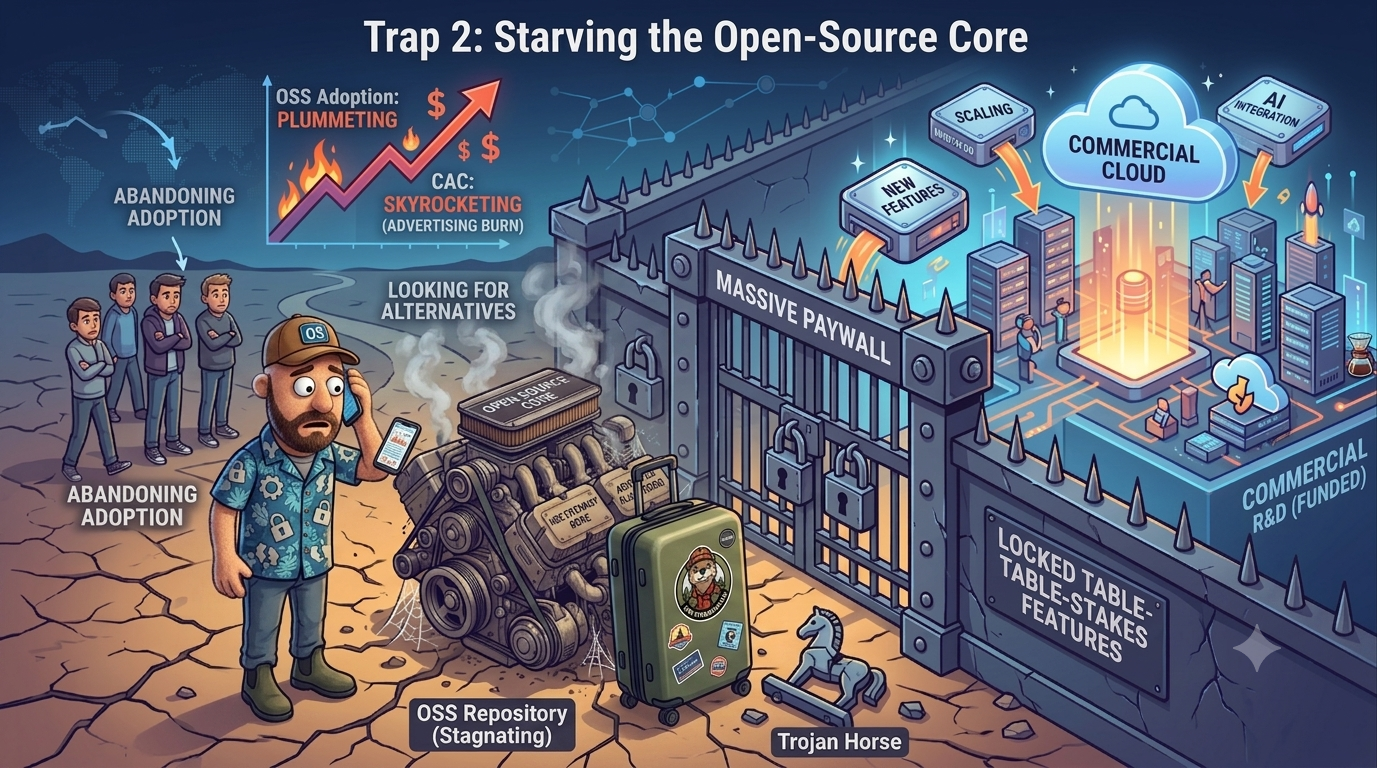
If the open-source version is too painful to use, developers will never adopt it. The Trojan Horse never makes it past the gates, and the entire top-of-funnel engine collapses.
When organic adoption dies, your Customer Acquisition Cost (CAC) skyrockets. A healthy COSS company sources 60% to 80% of its pipeline organically. Without it, your CAC payback period stretches from a highly efficient 9–12 months out to 24+ months. You end up burning capital on paid ads trying to artificially replicate organic growth.
03. Trap 3: The "Loud Minority" Roadmap Hijack
When community channels are run directly by highly technical co-founders and elite teams, it creates an incredible, high-touch feedback loop.
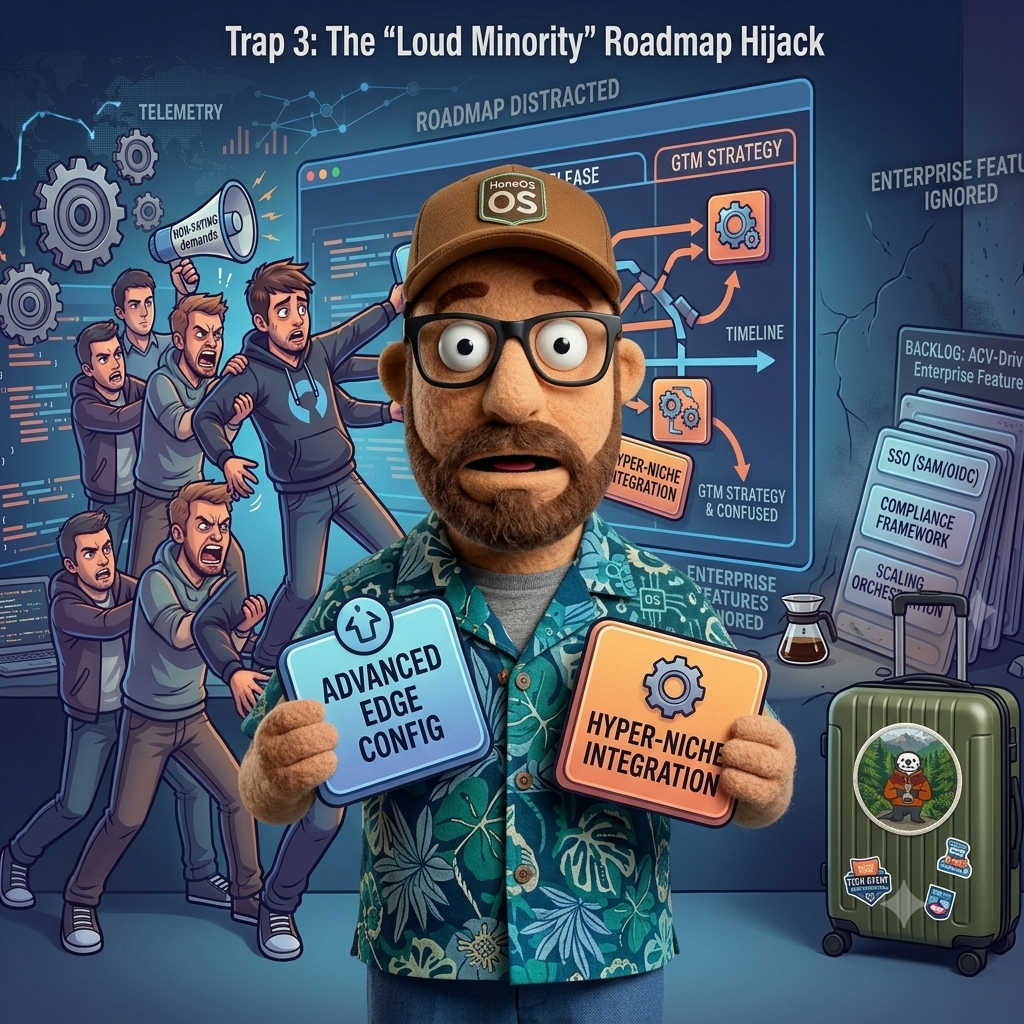
But there is a hidden danger: the loudest open-source users often demand highly specific, complex edge-case features.
If the product team blindly builds these into the OSS core to appease vocal power users, it distracts from the overarching GTM strategy. The product roadmap gets hijacked by non-paying users, while the features that actually drive ACV for enterprise buyers are pushed to the backlog.
04. Trap 4: The Frictionless-to-Cloud Failure
Many founders assume that building a great open-source project will naturally translate to easy adoption of their hosted cloud offering. They treat the managed service as an afterthought.
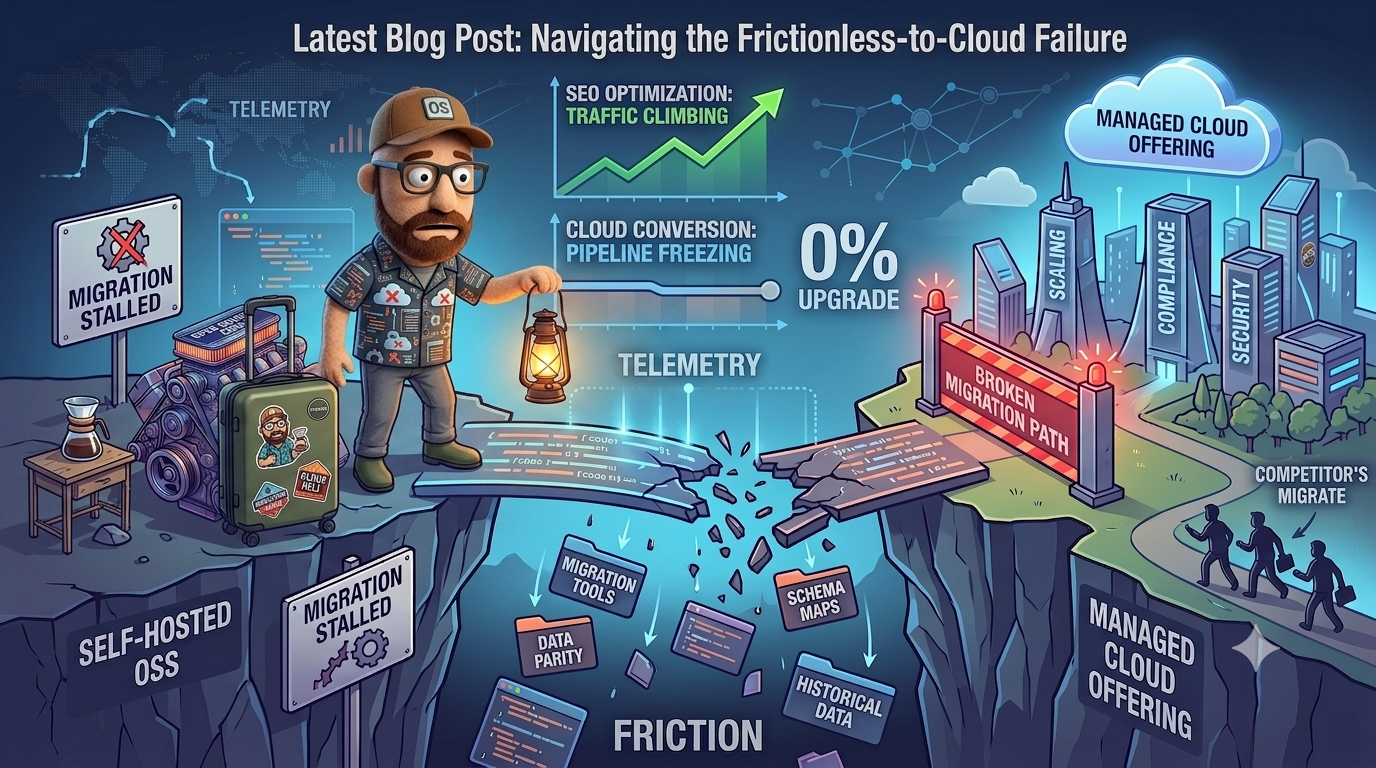
When launching a managed cloud offering, the GTM strategy will stall immediately if the migration path from self-hosted OSS to the cloud is broken. If the managed cloud lacks parity, or if migrating historical data requires a massive engineering lift, the pipeline freezes.
All the SEO optimization and targeted campaigns in the world won't save you if the friction to upgrade outweighs the pain of self-hosting.
05. Trap 5: Misjudging the Buyer vs. The User
The open-source user is the developer. The commercial buyer is the CISO, VP of Engineering, or Procurement.
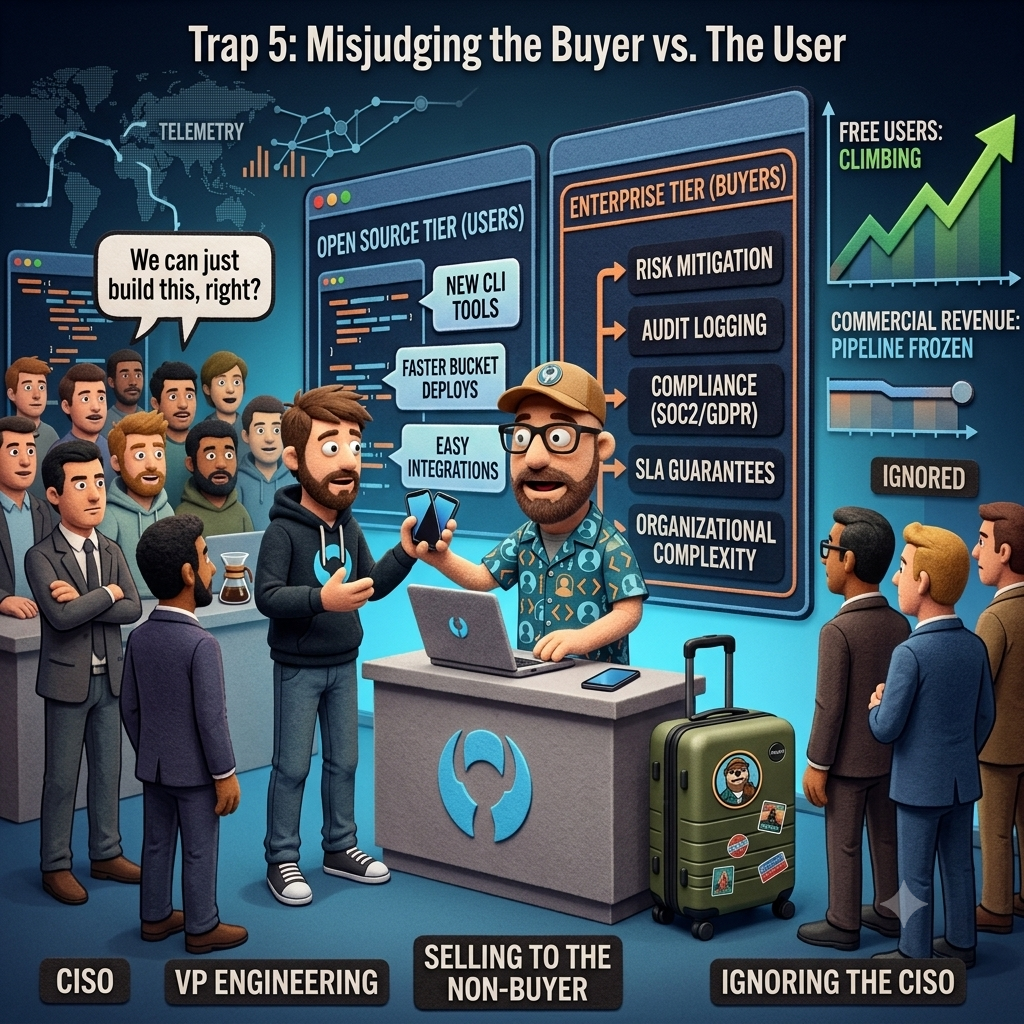
A fatal GTM trap is trying to sell developer features to developers. Developers are notoriously allergic to spending money on tools they believe they can build or manage themselves.
The OSS tier should make the developer's life infinitely easier. The commercial tier must solve the business's problems—mitigating risk, meeting audit requirements, and managing organizational complexity.
The Breaking Point: License Panic and Community Revolt
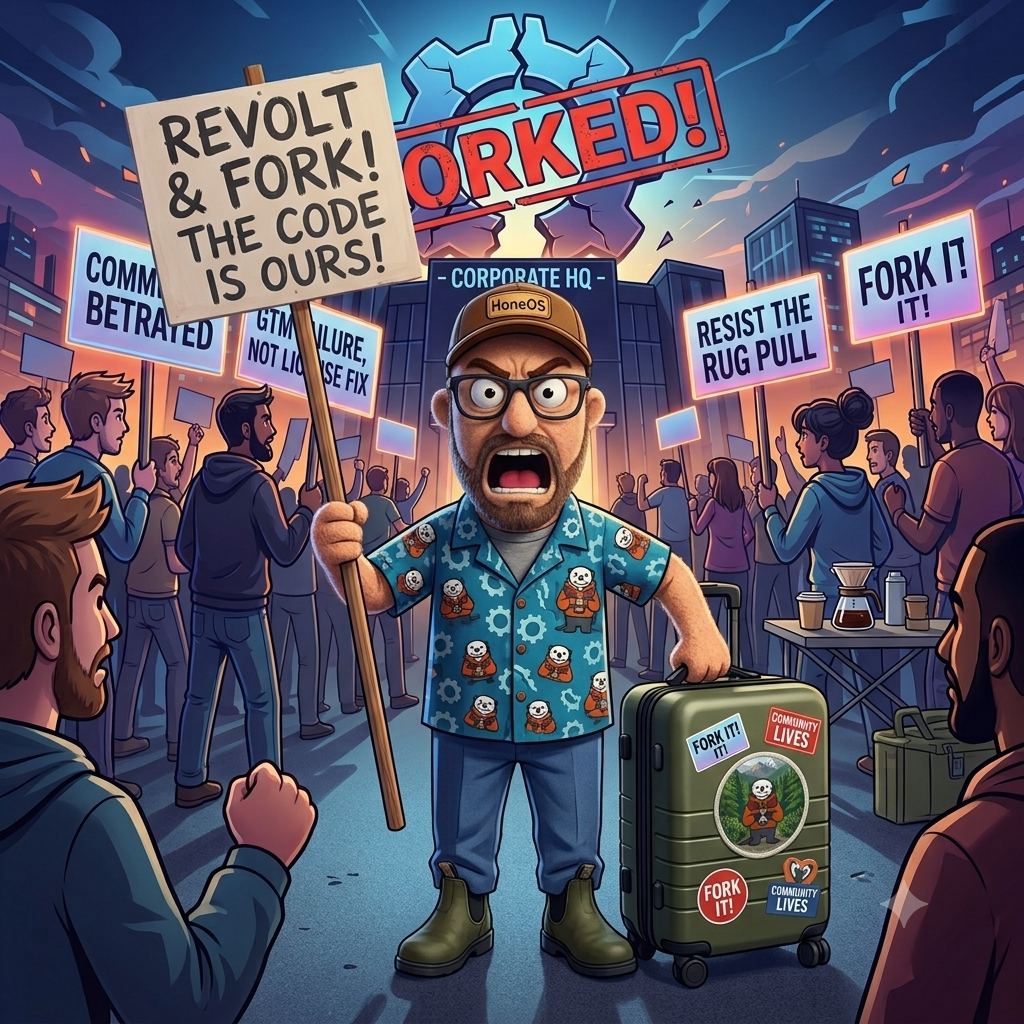
When a COSS company gives away too much and fails to build a sustainable pipeline, the inevitable result is a violent course correction.
We've watched some of the biggest names in infrastructure hit the limits of their monetization strategies and pull the ripcord on their licensing. Elastic moved to the Server Side Public License (SSPL), HashiCorp moved Terraform to the Business Source License (BSL), Redis abandoned BSD. CockroachDB followed suit.
These licensing shifts are almost always framed as a noble defense against predatory cloud providers, but let's be real: they are a symptom of a deeper Go-To-Market failure.
When the open-source product is so complete that enterprises don’t need the commercial tier, the monetization engine breaks. The resulting community backlash is brutal and swift, often resulting in hard forks (OpenSearch, OpenTofu, Valkey).
Changing your open-source license is a desperate attempt to retroactively fix a broken GTM strategy. The true solution isn’t to pull the rug out from under your community; it is to build a commercial intelligence engine.
The Solution: Optimizing Sales Intelligence
To avoid license panic and build sustainable revenue, your GTM engine must stop tracking vanity metrics like GitHub Stars or raw downloads, and start identifying true enterprise readiness.
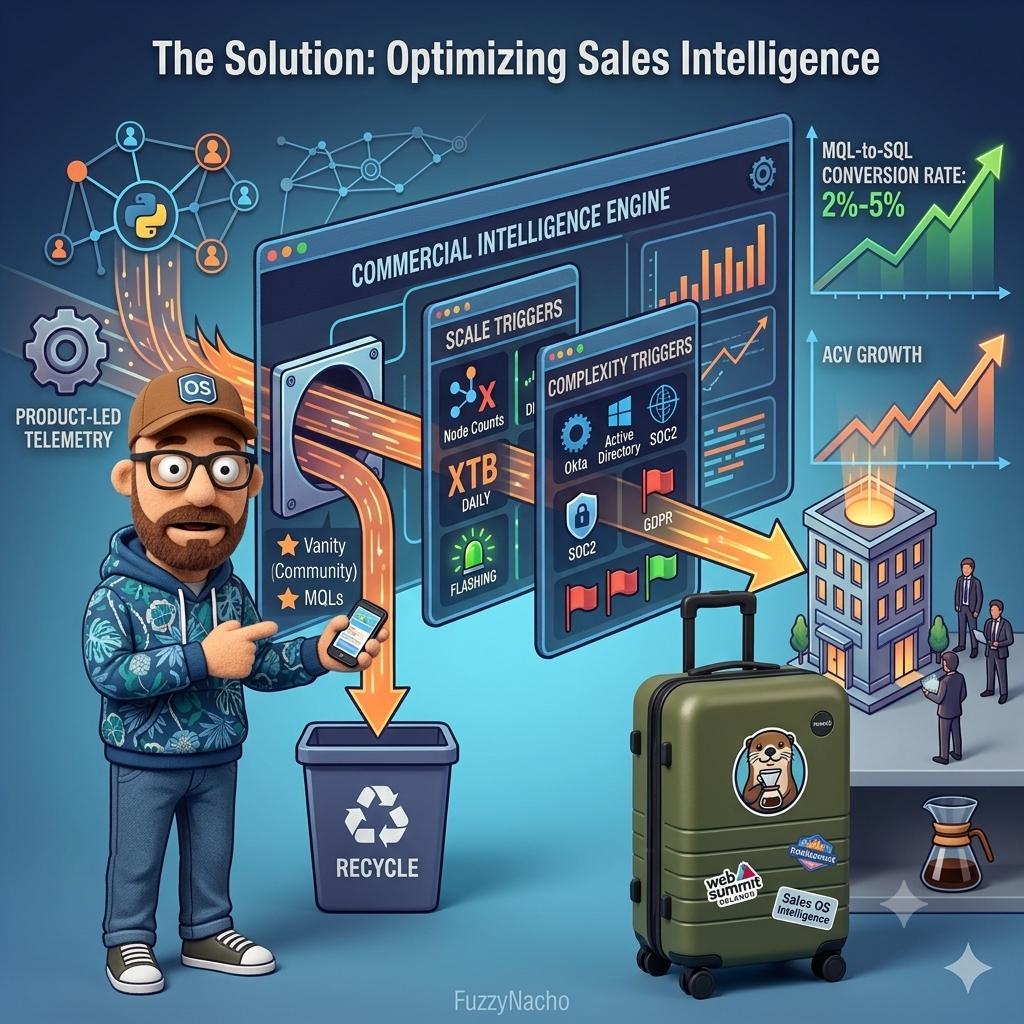
A proper commercial intelligence engine looks for product-led telemetry thresholds that indicate a business needs to upgrade:
- Scale triggers: Crossing specific node counts or processing massive daily data volumes.
- Complexity triggers: Attempting to integrate with external identity providers (Okta/Active Directory) or utilizing advanced compliance frameworks.
When an organization crosses these specific, measurable thresholds, they graduate from community user to enterprise prospect. By understanding exactly when and why an enterprise needs to upgrade, and ensuring your product tiers reflect that journey, you protect your community while building a resilient commercial pipeline.