You've said it a thousand times this quarter. You're on a Zoom call with a Director of Engineering, leaning into the camera, and delivering the ultimate COSS value proposition:
"Don't waste your precious engineering cycles building this internal tooling from scratch. Your team's time is too valuable. Buy our Enterprise platform so they can focus on what actually moves the needle for your core product."
It's a winning argument. It's why companies move from OSS to Enterprise.
But then the call ends. You close your laptop lid, take a breath, and spend the next four hours manually scraping LinkedIn, scouring GitHub commit logs, and hunting through the transcripts of obscure YouTube tech talks just to find one relevant reason to send a single outbound email.
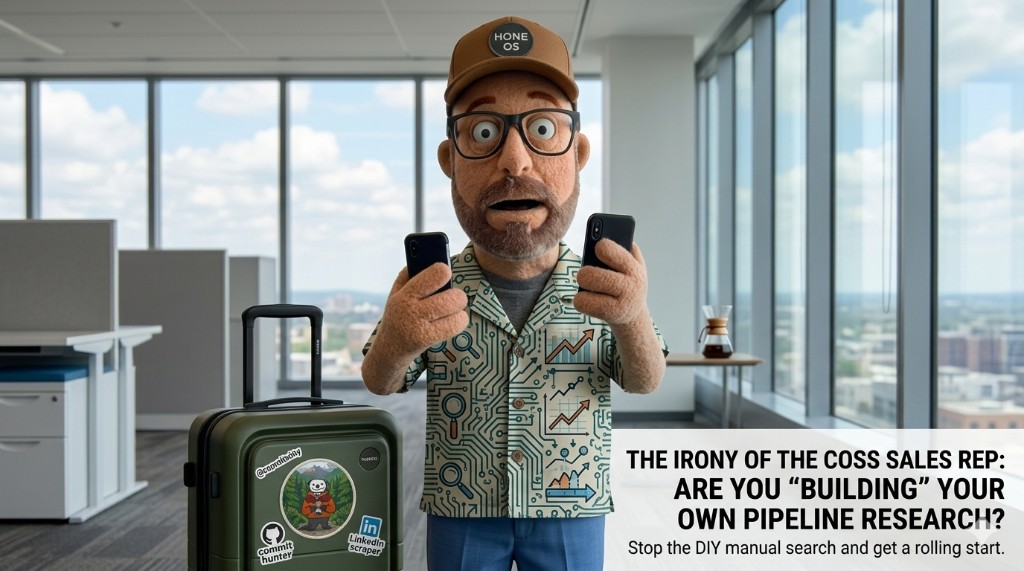
The irony is deafening. You are "building" your account research from scratch every single day. Just like the DIY software your customers try to hack together, your manual research process is unscalable, expensive, and likely outdated by the time it's "deployed" into your workflow. In the world of Commercial Open Source, it's time to apply the "Build vs. Buy" logic to your own desk.
Beyond the Email Address: What Actually Makes an OQL in 2026?
We all have the basics. In 2026, if your "lead data" consists of a name, a corporate email, and a LinkedIn profile, you don't have a lead — you have a phone book.
A "good" lead in the COSS ecosystem is defined by context and timing. Basic intent data, like seeing a prospect visit your pricing page, is a lagging indicator. To win, you need to identify the Open Source Qualified Lead (OQL). This requires a "rolling start" — identifying the signals that live beneath the surface of the repo and the job boards before the prospect even realizes they need to talk to you.
Decoding the "Dark Matter" of Engineering Intent
To get that "rolling start," you have to look for the "Dark Matter" — the data points you can't find unless you're willing to lose 20 tabs in your browser.
1. The "Hiring Pulse" as a Project Clock
When you see an account hiring a fleet of DevOps engineers or SREs with specific skills (e.g., Rust, Kubernetes, or Vector DB experience), you aren't just looking at job openings. You're looking at a project timeline.
- The Insight: A hiring spree six months ago means they are likely in the "Scaling/Pain" phase now. Conversely, if they are actively hiring a specific engineering role today, they are hitting a complexity wall where your Enterprise offering is the exact lifeline they need.
2. Dependency Friction & Shadow Feature Building
These are the technographic signals you literally cannot find on your own without a data science degree:
- Dependency Friction: Knowing a prospect is 3 versions behind on the OSS core. This isn't just "old tech"; it's a massive signal that they lack the internal tooling to upgrade safely — a primary Enterprise value prop.
- Shadow Feature Building: Spotting when a prospect's engineers are contributing patches to the OSS repo to hack together their own version of your Enterprise "Role-Based Access Control" (RBAC) or security auditing. They have the pain; they just don't have the "Buy" mindset yet.

Timing the Friction: "Knowing is Half the Battle"
There is a misconception in COSS sales that you just need to blanket your open-source users with upgrade emails. But in 2026, buyers' inboxes are flooded with AI-generated noise. If you are blasting generic feature updates, you're just adding to the mess.
The key to COSS sales isn't shouting the loudest; it's reaching out the right way, at the exact moment. If an organization has been happily using your open-source version, the moment to strike is when they approach the limits of the community edition — scaling limits, compliance hurdles, or management overhead. As G.I. Joe said, "Knowing is half the battle." You have to know when that pain is hitting to make your outreach meaningful.
The Manual "Build" Path: A Guide for the DIY Rep
If you're determined to do this manually, here is your toolkit. (Warning: This will take roughly 60% of your selling week.)
- GitHub Advanced Search: Search for domain-specific contributors and "Fork" activity to measure intent intensity.
- Hacker News / Stack Overflow: Search for your tech niche to see what engineers at your target accounts are complaining about.
- YouTube Transcript Search: Scour "Cloud Native" or "DevOps" event recordings to see if a prospect's engineer mentioned a specific pain point during a Q&A session.
Why "Buying" the Intelligence Wins
The problem isn't that you can't find this info. The problem is that while you are finding it, your competitor — who started with a rolling start — has already booked the meeting.
HoneOS Vision is the "Enterprise Buy" for your sales workflow. It automates the "Dark Matter" research by codifying 20 years of technical sales expertise into an automated Logic Layer. It tracks the obscure tech talks and analyzes the hiring pulses across your entire territory simultaneously.
The Math of the Rolling Start
| Activity | Manual Build (DIY) | HoneOS Vision (Buy) |
|---|---|---|
| Research per Account | 45–60 Minutes | < 60 Seconds |
| Contextual Accuracy | Human Error / Guesswork | Data-Backed Expert Logic |
| Daily Reach | 5–10 Accounts | 50+ Accounts |
| Focus | Searching | Selling |
The Bottom Line: Stop Digging. Start Acting.
If you wouldn't tell your customer to build their own database, why are you still building your own research?
Stop wasting your elite talent on the discovery tax and start leading with a verified "Why Now" trigger. Use HoneOS Vision to bridge the gap between "Who do I call?" and "What do I say?"
Get a rolling start. Stop searching and start selling.